Frequently asked questions.
How physiology-based authentication resists spoofing, keeps data on the device, and deploys into your existing flows.
Security & anti-spoofing
Can A-Live® be fooled by a deepfake or AI-generated video?
No. Deepfakes defeat systems that rely on what a person looks or sounds like — a face, a voice, a selfie. These are files that can be played back. A-Live® uses none of those. A-Live® uses a live signal that reads neuromuscular micro-vibrations through the motion sensors already in your device — no camera, no image, no recording. There is nothing to deepfake.
How is Touch Technology® different from fingerprint, face, or voice recognition?
Those are static features — a fixed pattern that can be copied, replayed, and, once leaked, never reissued. Touch Technology® uses a live signal generated by your nervous system that exists only at the moment of authentication and is never stored.
Why are traditional biometrics increasingly vulnerable?
Two reasons. They can be spoofed — fingerprints lifted from photos, voice systems fooled by relatives, face recognition defeated by generative AI. And they store a reference file, on the device or in the cloud, that becomes a permanent liability in a breach — you can’t reissue a face. You cannot get or buy new fingers. Not convinced? Read about IDEMIA’s Aadhaar catastrophe in India.
What NIST standards are Aerendir®’s products compliant with?
The authorization architecture was informed by established standards for identity assurance, authentication, cryptographic key management, and zero-trust security, including FIDO2, WebAuthn/CTAP, NIST PIV, NIST Zero Trust Architecture, NIST SP 800-57, and FIPS requirements.
Privacy & data
What data do you collect or store?
None. Touch Technology® runs every product on-device. No biometric data, nor personal data, are collected, stored, or transmitted — recognition is a live computation, not a comparison against a saved file. Nothing leaves the device, so there is no database to breach.
Is anything processed in the cloud?
No. Everything happens on the device, using its own sensors and chip — Cloudless AI. Our models are pre-trained and cover 99% of all products available on the market. No cloud calibration, no transmission of biometric data.
What Touch Technology® does
What is A-Live®?
A-Live® answers “Is a human present?” It gates human access to systems, services, and credentials by passively detecting human presence through neuromuscular micro-vibrations captured by commodity IMU sensors — no cameras, no challenges, no friction. It runs entirely on-device, returns a result in 0.5 seconds, and integrates into any existing login or access flow via SDK/API. It can extend to laptops and consoles, using a phone as a second factor.
What is A-Tag™?
A-Tag™ answers “Did a human make this?” It establishes human provenance across digital content, allowing for copyright protection for creators.
What is A-Cert®?
A-Cert® answers “Is the right person authorizing it?” It binds credentials to the legitimate user.
What is AerWheel™?
AerWheel™ answers “Is this driver aware?” It extends physiology-based trust into regulated, safety-critical, and compliance-driven environments such as automotive.
Integration & deployment
How do I integrate Aerendir®’s solutions?
Via SDK/API. A-Live® and A-Tag™ drop into any existing flow. Integration time is days or weeks, not months. A-Tag™ is also available as an app for creators looking to protect their work.
What hardware is required?
Nothing beyond the device itself. Touch Technology® uses the commodity IMU sensors — accelerometer and gyroscope — standard in smartphones and tablets. No cameras, no special hardware, no external readers. We cover 98% of all existing mobile devices on the market.
Does it work offline?
Yes. Because everything runs on-device, authentication works with no network connection.
What does pricing / licensing look like?
Licensing plus SDK — contact us.
The science
How does Touch Technology® actually work?
Your brain continuously controls your muscles through tiny, involuntary micro-vibrations, unique to your individual neuromuscular anatomy. This will be our biometric authenticator, called NeuroPrint®, operating on a phone. Touch Technology® reads those signals through your device’s motion sensors to confirm a real, present human.
Is everyone’s signal really unique?
Yes. It derives from the structure of your brain, nerves, and muscles, which differ from person to person — even between identical twins.
Company
Do you hold patents?
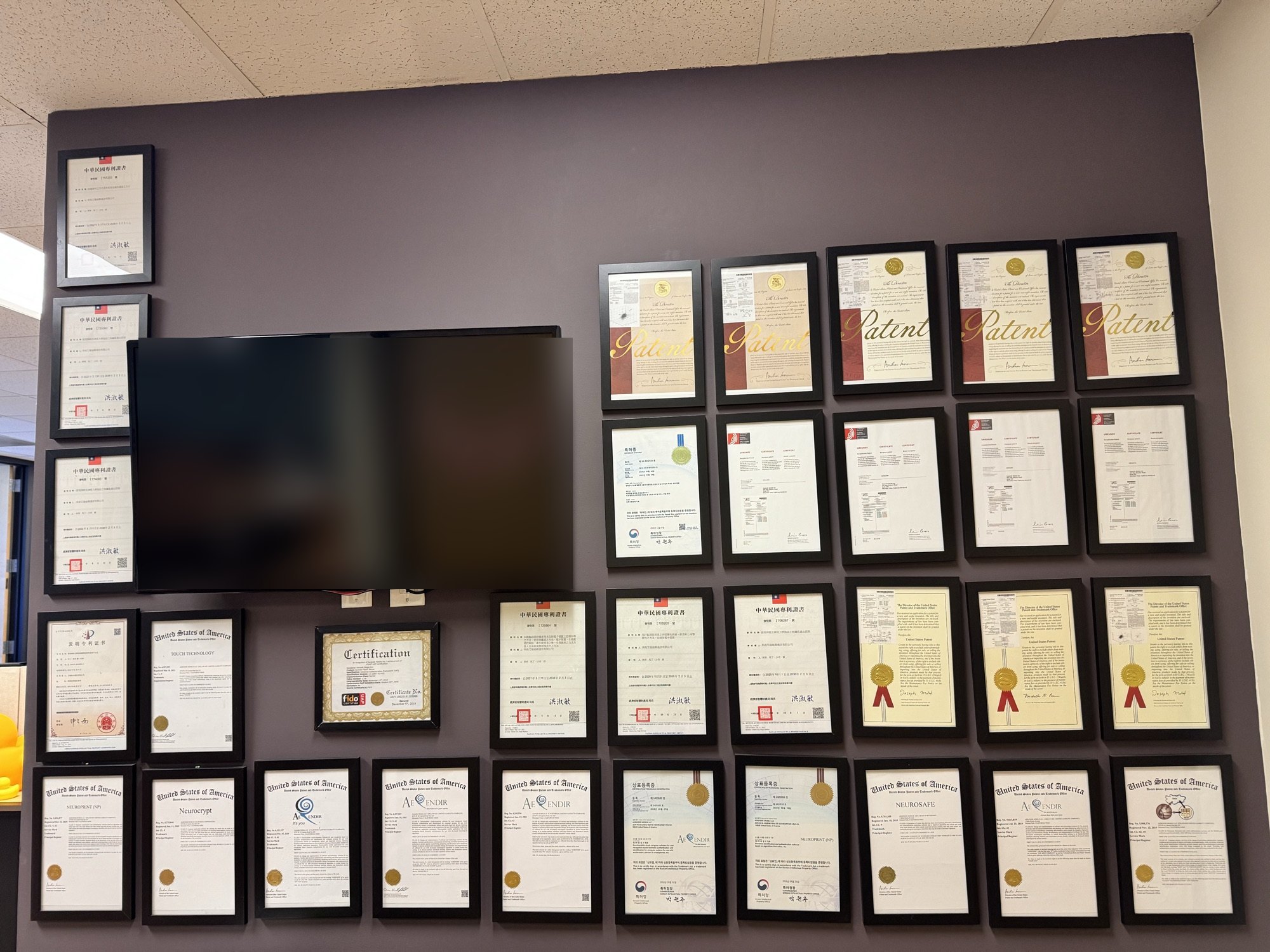
Yes — we have 35 granted patents and 26 pending. We have patents covering major markets like in the U.S., E.U., Korea, and Taiwan. Here’s a sample: